

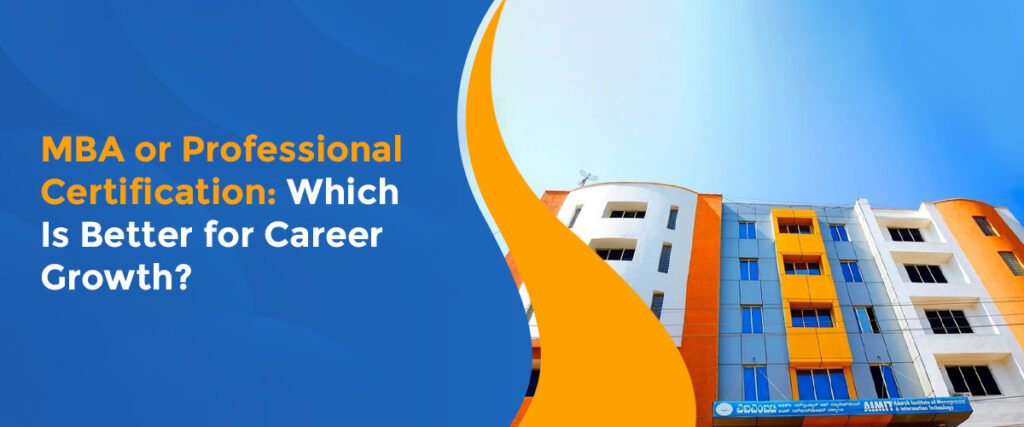
MBA or Professional Certification: Which Is Better for Career Growth?
Choosing the right qualification after graduation can shape your professional journey. With businesses increasingly looking for candidates who combine knowledge, practical skills, and adaptability, many students face an important question: Should I pursue an MBA course or choose a professional certification?
Both options can support career development, but they serve different purposes.
An MBA provides a broad understanding of business management, leadership, finance, marketing, and organisational strategy. Professional certifications, on the other hand, generally focus on developing specific skills within a particular field.
If you are planning your MBA career or considering a short-term professional qualification, understanding these differences can help you make an informed decision.
This guide compares an MBA and professional certifications based on learning outcomes, duration, career opportunities, costs, and long-term professional goals.
What Is an MBA Course?
A Master of Business Administration (MBA) is a postgraduate degree designed to develop business knowledge, management capabilities, leadership skills, and strategic thinking.
A typical two-year MBA course covers Marketing Management, Financial Management, Human Resource Management, Business Analytics, Operations Management, Strategic Management, and Entrepreneurship and Innovation.
The programme usually begins with foundational management subjects before introducing advanced concepts and specialisation electives.
An MBA is particularly relevant for graduates who want to understand how businesses operate and develop the capabilities required for management-related roles.
At Adarsh Institute of Management and Information Technology (AIMIT), Bengaluru, the two-year full-time MBA programme combines academic management education with practical learning and professional development activities.
What Is a Professional Certification?
A professional certification is a qualification or credential that demonstrates knowledge or competence in a specific subject or skill area.
Depending on the provider and industry, certification programmes may focus on Digital Marketing, Financial Analysis, Data Analytics, Project Management, Human Resource Practices, Business Intelligence, Supply Chain Management, or Technology and Software Applications.
Some certifications require formal examinations, while others involve coursework, practical assessments, or completion-based learning.
Unlike an MBA, which covers multiple management disciplines, a professional certification typically concentrates on a narrower skill set.
For example, a digital marketing certification may focus on campaign planning, analytics, and online advertising, while an MBA in Marketing explores broader subjects such as consumer behaviour, marketing strategy, brand management, and business decision-making.
The value of a certification depends on its curriculum, assessment standards, recognition, relevance, and practical application.
MBA vs Professional Certification: Key Differences
Before deciding which option is better for your career, compare their fundamental characteristics.
| Factor | MBA Course | Professional Certification |
|---|---|---|
| Qualification | Postgraduate degree | Skill-specific credential or certificate |
| Duration | Typically two years for a full-time MBA | Often weeks to months; varies by programme |
| Learning Focus | Broad business and management education | Specialised technical or professional skills |
| Curriculum | Multiple management disciplines and electives | Focused subject-specific modules |
| Practical Learning | Projects, case studies, internships, presentations | Exercises and assessments, depending on provider |
| Career Direction | Management, business, analytical and leadership-related pathways | Skill enhancement or specific professional functions |
| Networking | Faculty, peers, alumni and industry interactions | Varies by programme and provider |
| Cost | Usually larger financial and time commitment | Often lower, but varies considerably |
| Long-Term Value | Broad management foundation and academic qualification | Proficiency in particular skills |
Neither option guarantees employment or promotion. The better choice depends on your current qualifications, professional experience, financial situation, and career objectives.
1. Which Option Is Better for Building Management Skills?
If your goal is to understand business operations and develop broader managerial capabilities, an MBA course may be more suitable.
MBA programmes introduce students to multiple organisational functions. For example, a marketing manager needs to understand more than advertising. Budgeting, customer behaviour, team management, operational planning, and business strategy may all influence marketing decisions.
An MBA helps students examine these interconnected responsibilities. Professional certifications usually provide greater depth in a specific subject but may not cover the wider business context.
Choose an MBA if you want structured education in business management, leadership, strategy, and cross-functional decision-making. Consider a certification if you want to improve a particular professional skill without committing to a full postgraduate degree.
2. MBA or Certification: Which Is Better for Career Opportunities?
Career opportunities depend on industry requirements, employer expectations, individual skills, and professional experience.
An MBA may be relevant for business development, marketing and brand management, financial analysis and management, human resource management, business analytics, operations and supply chain management, management trainee programmes, and entrepreneurship.
Professional certifications may support opportunities in specialised areas such as digital advertising, financial modelling, analytics software, or project management.
However, completing either qualification does not automatically make someone eligible for every role. Some positions require prior experience, technical proficiency, industry knowledge, or additional credentials.
When planning an MBA career, consider the type of responsibilities you want to handle rather than focusing only on job titles.
3. Which Qualification Is More Useful for Career Growth?
Career growth involves more than securing your first job. As professionals gain experience, they may need to manage teams, evaluate business performance, communicate with stakeholders, and make strategic decisions.
An MBA can help develop the broader management understanding relevant to these responsibilities. Professional certifications can be useful when career progression requires proficiency in a particular technology, process, or professional discipline.
For example, someone working in marketing may benefit from a certification in marketing analytics to improve campaign measurement skills. The same professional may consider an MBA to build a broader understanding of brand strategy, business finance, and organisational management.
Therefore, an MBA and professional certification should not always be viewed as competing choices. They can complement each other at different stages of a career.
4. MBA Course vs Certification: Which Offers Better Practical Learning?
Practical learning is important because employers often expect candidates to apply knowledge to real business situations.
MBA programmes may provide practical exposure through case-study discussions, group assignments, business presentations, industry visits, internships, research projects, and entrepreneurship activities.
Professional certifications may provide hands-on learning through software exercises, simulations, assessments, or practical assignments.
An MBA generally connects practical activities to wider management concepts, while a certification focuses on demonstrating competence in a specific area.
At Adarsh AIMIT, students can explore management education supported by workshops, seminars, industrial interactions, projects, and professional skill development initiatives. These activities are intended to connect academic learning with workplace expectations.
5. What About Course Duration and Flexibility?
Time commitment is an important consideration, particularly for students who need to begin working quickly or professionals balancing employment with education.
A traditional full-time MBA generally requires two academic years. This provides time for foundational subjects, specialisation studies, assignments, projects, and student development activities.
Professional certifications can often be completed in shorter periods. Some are self-paced, while others follow fixed schedules or require supervised examinations.
However, certification duration varies significantly. A short online course and a rigorous professional credential may have very different requirements.
Before enrolling, compare the actual learning hours, assessment standards, and practical components.
6. MBA vs Certification: Which Is More Cost-Effective?
Cost-effectiveness depends on more than the initial course fee.
An MBA usually involves a larger financial commitment because of its duration and academic structure. Students may also need to consider living expenses, travel, study materials, and the opportunity cost of full-time education.
Professional certifications can be more affordable, especially when they focus on a limited skill set. However, advanced professional qualifications may involve substantial examination, training, or renewal costs.
When comparing the options, ask: What is the complete programme cost? How much time will I need to invest? Which skills will I develop? Is the qualification relevant to my target career? Does the programme include practical learning? What evidence is available about student outcomes?
Avoid choosing a qualification based only on advertised salary figures or promises of quick career advancement. A better investment is one that aligns with your long-term goals and circumstances.
7. Which Is Better for Fresh Graduates?
Fresh graduates often need to build both professional knowledge and career direction.
An MBA course can provide structured exposure to business functions, helping students explore areas such as Marketing, Finance, Human Resources, Business Analytics, and Operations Management. It may be especially relevant for graduates who want to move into management-related career pathways.
A professional certification may be useful when a student already knows which skill or occupation they want to pursue.
For example, a graduate interested in digital marketing may begin with a focused certification to learn campaign tools and analytics. A graduate seeking a broader understanding of business management may prefer an MBA.
The decision should depend on the student's interests, financial readiness, eligibility, and career plans.
8. Which Is Better for Working Professionals?
Working professionals should evaluate their existing experience before choosing a qualification.
A certification may be suitable if the immediate objective is to acquire a new technical skill, meet a professional requirement, or improve performance in a current role.
An MBA may be useful for professionals who want to strengthen their management knowledge or prepare for broader business responsibilities. However, a full-time MBA involves a substantial time commitment.
Professionals should carefully evaluate whether they can accommodate the programme structure. It is also important to distinguish a full-time MBA from other management programmes with different delivery formats.
Choose a qualification that fits your professional responsibilities and learning needs.
9. Can You Pursue an MBA and Professional Certifications Together?
Yes. In many cases, combining an MBA with relevant certifications can create a complementary learning pathway.
An MBA develops broader management knowledge, while certifications can help demonstrate proficiency in specific tools or skills.
| MBA Specialisation | Complementary Skill Area |
|---|---|
| Marketing | Digital marketing, marketing analytics |
| Finance | Financial modelling, spreadsheet analysis |
| Human Resource Management | HR analytics, recruitment technology |
| Business Analytics | Data visualisation, analytics software |
| Operations Management | Process improvement, supply chain analytics |
| Entrepreneurship | Digital business tools, financial planning |
These are illustrative combinations rather than mandatory qualifications. Students should avoid collecting certifications without a clear purpose. Focus on skills that support your academic interests and intended career direction.
10. How to Decide Between an MBA and Professional Certification
Step 1: Define Your Career Goal
Do you want to develop broad management capabilities or acquire a specific professional skill? A clear objective will help you identify the most relevant qualification.
Step 2: Review Your Existing Knowledge
Consider what you already know from graduation, internships, or employment. Choose a programme that builds on your strengths while addressing important skill gaps.
Step 3: Evaluate the Curriculum
Do not rely only on programme titles. Review the subjects, practical assignments, assessment methods, and learning outcomes.
Step 4: Consider Time and Budget
Calculate the full cost and time commitment before enrolling. Choose an option that is financially manageable and realistic for your circumstances.
Step 5: Research Career Requirements
Review the qualifications and skills commonly expected for the roles you want to pursue. This can help you determine whether a degree, certification, practical experience, or combination is most relevant.
Why Consider Adarsh AIMIT for Your MBA Career?
Adarsh Institute of Management and Information Technology (AIMIT), Bengaluru, offers a two-year full-time MBA programme affiliated with Bengaluru City University.
The programme focuses on academic management education alongside practical exposure and professional development.
For students considering an MBA career, the institute highlights several aspects of its learning environment.
Management Specialisation Options
Students can explore management disciplines including Finance, Marketing, Human Resource Management, Business Analytics, Entrepreneurship and Startups, and Production and Operations Management. Specialisation availability and elective combinations are subject to the applicable programme structure.
Industry-Oriented Learning
Adarsh AIMIT highlights workshops, seminars, industrial visits, projects, and industry interactions that help students connect management concepts with practical business situations.
Professional Skill Development
Through Adarsh Finishing School and related initiatives, the institute emphasises communication, presentations, aptitude, leadership, and career preparation.
Career Guidance and Placement Assistance
The institute also highlights mentoring, internships, career counselling, and placement assistance as part of its student development approach. Prospective students should confirm the latest programme details, eligibility criteria, fees, and admission requirements directly with the institute.
Conclusion
The choice between an MBA and a professional certification depends on what you want to achieve in your career.
An MBA course offers a broad understanding of business management, leadership, strategy, and organisational functions. Professional certifications provide focused learning that can help individuals develop or demonstrate particular skills.
For fresh graduates seeking structured management education, an MBA may provide a useful foundation. For professionals looking to strengthen a specific skill, a certification may be a practical option.
In many cases, the strongest learning pathway combines broad business knowledge with relevant specialised skills.
If you are planning an MBA career and want to explore management education in Bengaluru, Adarsh AIMIT offers a full-time MBA programme with specialisation options, practical learning activities, and professional development support.
Build your management knowledge and explore the next step in your career with Adarsh AIMIT.
Visit: https://adarshaimit.org/